This post is about a concrete app I’ve built recently, but I’m really trying to make a broader point here about embracing technology so that it is useful for us, humans, without making us tired, distracted, overstimulated and lost. (I also share a few thoughts on how I applied Security by Compartmentalization approach to securing a multi-user web service.)
When Tim Berners-Lee invented the Web1 at the dawn of the 1990s, those who knew about Memex2 no doubt saw it in his invention. As a small kid, I didn’t know about it back then. In fact I didn’t know about it for a few more decades. Yet, even in Poland, I was able to see the mounting enthusiasm for the Web as early as the mid-1990s. Many people got excited about how it would make us smarter, more sophisticated, productive, all-knowing, wise. Everyone would have access to all the libraries of the world and would be able to learn about anything they wanted! And yet, nearly four decades later, I doubt the Web made us smarter. Or wiser. Or happier.
I must admit I dislike the Web. I dislike its infinitely clickable rabbit holes, its attention-grabbing nature, its (lack of) aesthetics, its cult of consumerism. That it always tries to sell me something. I dislike that it is so impersonal. I cannot draw on websites, nor can I arrange them the way I would like.
When Steve Jobs was introducing the world to the smartphone, back in 2007, I was watching his keynote. I liked that shiny gadget he was presenting and was sad it was not available in Poland back then. Nearly twenty years later, I think smartphones have made us less happy. I dislike those endlessly scrollable, always distracting, overstimulating devices.
And yet, the Web and the smartphone are truly marvelous inventions. It’s hard to throw them away in the name of peace of mind. They are gateways to knowledge, productivity, communication — pretty much everything in the modern world. So, what do we do?
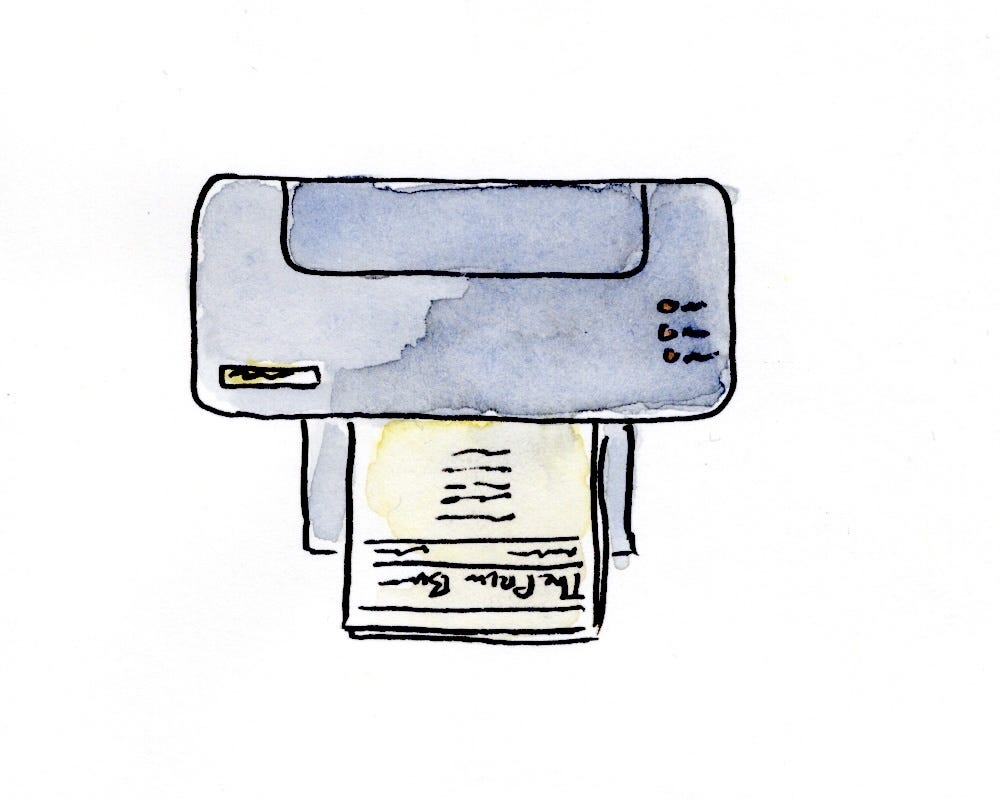
Printed generates morning briefs as PDFs or ePUBs, deterministically from user-defined sources
OK, I’m not going to propose a replacement for the Web and the smartphone, not yet, at least ;) But today I present a tiny piece which could somehow replace them in one specific activity: the morning reading of news and all those articles saved for “reading later” (which normally never happens).
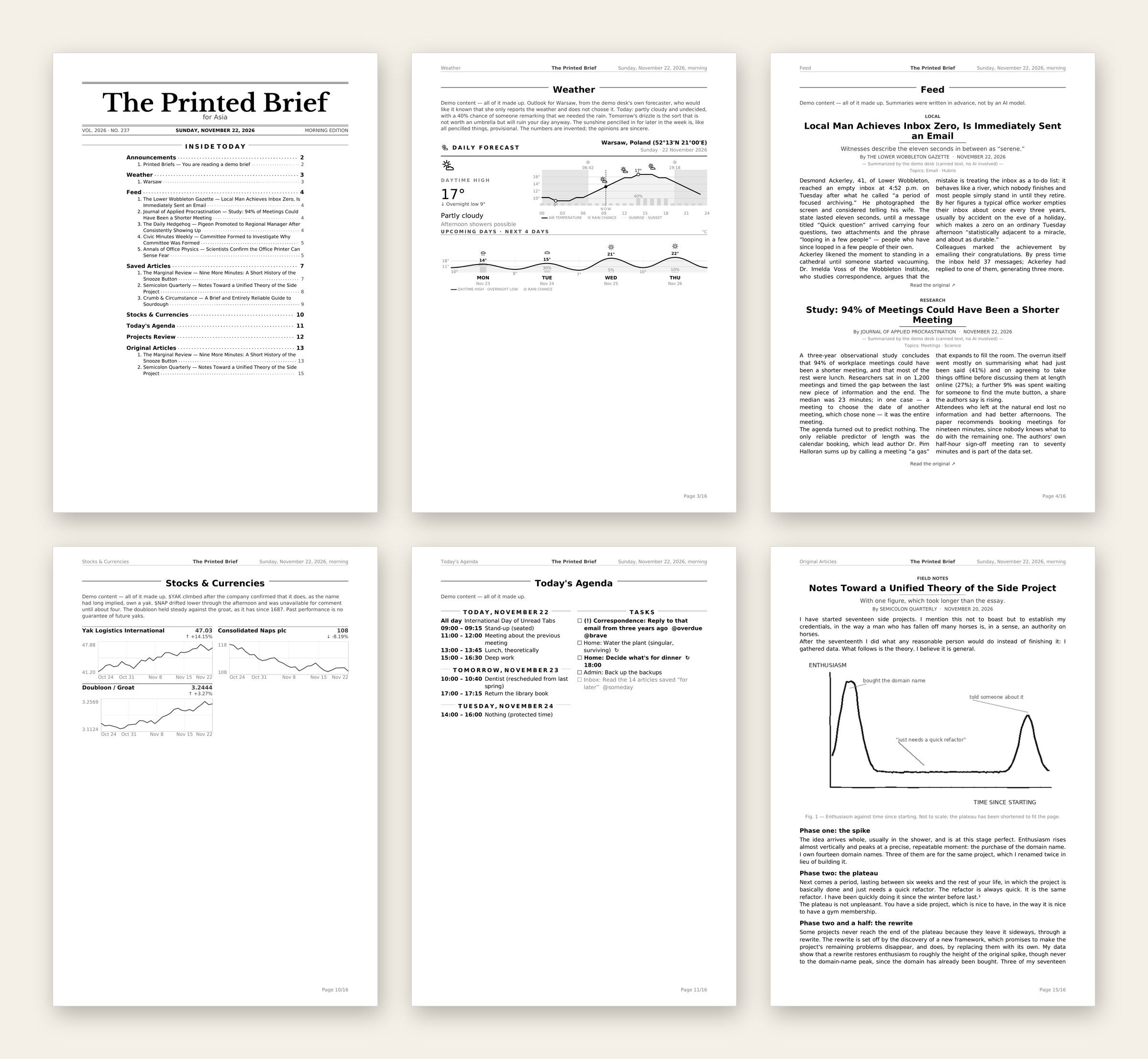
My tiny piece is called Printed because it’s a service which generates print-ready briefs in the form of a PDF or ePUB. Briefs are generated deterministically from user-defined sources — RSS feeds, Readwise Reader’s and Instapaper’s saved articles and subscribed newsletters, weather, calendar and tasks.
You can then either print them on a real printer or copy them to an e-ink tablet. I’m personally faithful to reMarkable’s tablets, which I have been happily using for over 7 years, but of course there are many more devices out there.
Core concept — Don’t Trust Yourself!
This might sound like no big deal, but I believe it actually is. The static, self-contained nature of a “printed” PDF changes the context in which your brain operates. You just read whatever articles are there and that’s it. Finito. Done. There is no diving into a rabbit hole with each and every oh-so-fascinating topic you encounter during your morning feed reading. You can surely mark interesting fragments with a pencil or a highlighter to check them later. But that “later” is an important game-changer.
My experience shows that out of several things I’d highlight during my morning read for further investigation, later, when I’d sit at a computer, say, I’d feel like going for maybe one and often for none at all. Suddenly they would not seem as worthy of my time. Because at that later moment my mind would already be occupied with something more interesting, e.g. the actual project I’m working on.
I consider this an important mechanism of mental hygiene. I gave up long ago on the idea that I shall learn and understand everything there is to know and understand.
In other words, Printed is built around an important concept I grasped only late in my life: to not trust myself! This applies to procrastination, eating, exercising, cleaning, keeping order, learning and working, and many other aspects of life. The conflict between what we want at the moment and what we want for ourselves in the long term. Between the Id and the Superego, if you will.
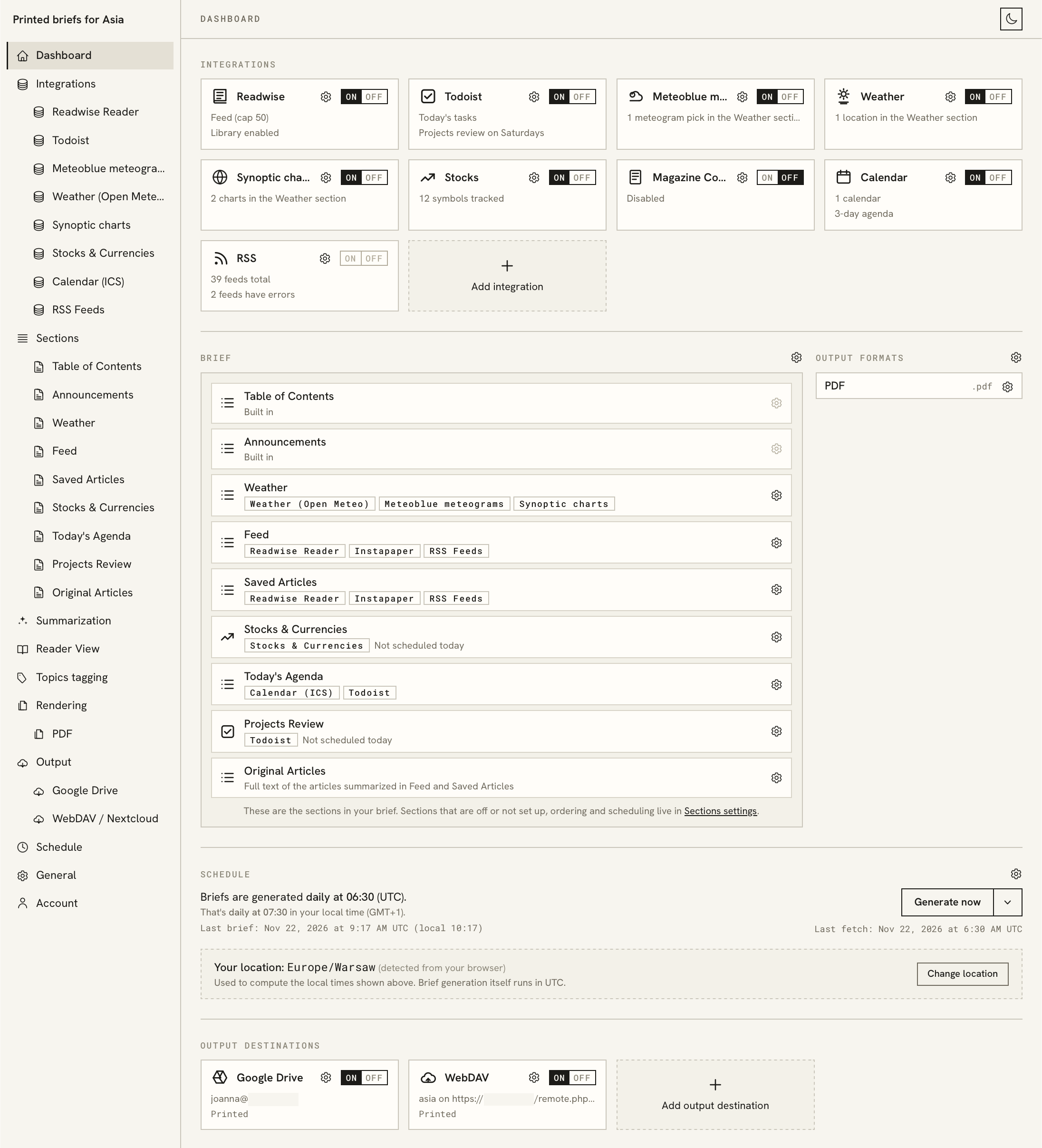
Briefs are automatically pushed to your WebDAV or Google Drive storage
Back to the briefs. They are generated as self-contained PDFs and are best consumed printed or on a minimalistic e-ink tablet, where you cannot get derailed from reading. Leave your phone far away!
As an added bonus, the paginated nature of the PDF format gives a nice feeling of tangibility, an easy way to gauge the quantity of information in the brief. Plus the ability to mark up the margins, a process which magically turns an impersonal piece of news into your own, personal note.
Briefs are generated at a configurable time, say 08:00, and automatically saved to your chosen storage. This allows you to get your brief without ever taking any screen-equipped device in your hands.
Currently there are two storage types supported: WebDAV and Google Drive. WebDAV allows you to use practically any self-hosted NAS as a destination for the briefs. Google Drive I added because my e-ink tablet of choice, mentioned above, supports only Google Drive or Dropbox for imports. Sad, but I’ve learnt to accept it.
Printed is live at printed.sh
Printed app is hosted at printed.sh. You can go there now, create an account, confirm your email, and start using the Free version immediately. It is limited to 9 briefs per month. Think of it as a trial version.
Then there is the Basic subscription, which costs 4 EUR per month and allows you to generate briefs every day. For 9 EUR monthly you get the Plus level (bear with me, I’m at the height of my marketing skills here), which currently differs primarily by also offering a built-in article summarizer (internally wired to OpenAI’s gpt-5.4-mini). On the Basic subscription you can instead connect your own LLM via OpenAI or Anthropic API keys. This should work equally well with your self-hosted models too.
The Plus subscription also has a higher cap on the number of articles per brief and on the maximum number of RSS feeds. I admit I’m in the initial phase of figuring out these limits in order to make the hosting financially self-sustainable, so I’m starting with stricter limits and will try to relax them over time.
Summarization of articles vs. original texts
A few words about this summarization feature. In short — I find it a good way to triage articles which I’d like to read in full. And I would like to keep it mainly for that and still actually read the original texts, words written by actual persons I decided to follow. Printed offers a few ways to help with that.
First, for sources such as RSS feeds, you can enable summarization per feed, meaning you can already decide that some authors you will always read in the original, while other feeds you might first pipe through summarization to see if the topic is really of interest to you.
Second, you can enable inclusion of the original texts (for each summarized article) at the end of the brief, and/or have Printed save the originals to your chosen storage in a separate tree indexed by source (e.g. Articles/tracesofhumanity.org/). The latter option would be useful for someone printing the briefs on an actual printer and wanting to keep the size of the briefs minimal.
How I use Printed personally
Anyway, let me show you a few practical ways I use Printed.
First, I’m subscribed to a number of newsletters. These are all forwarded to my Readwise Reader’s Feed folder. I could use the Readwise-generated email address and subscribe using that address, but I prefer to have more control and so use a forwarding rule on my mail service to send the newsletters to Readwise.
(I just happen to have been using Readwise Reader for many years, but I see that Instapaper offers very similar functionality. Printed has support for Instapaper as well.)
In addition, I subscribe to a number of RSS feeds directly via Printed. All this makes up my daily feed. For that feed I have summarization enabled (for the noisy RSS channels there is a handy “daily summary” option which combines all items since the last brief and summarizes them together. Very useful sometimes).
The second flow is for read-later articles. A typical case is someone sending me a very-interesting-link, which — at that very moment — I might not have the mental capacity to look at. What I do (typically on a phone) is send it to Readwise Reader (again, I could have used Instapaper as well), which puts it into the Library folder. Then I forget about it. Until the next morning, when my brief features this article in the “Saved Articles” section. This section also has summarization enabled, but with longer, more detailed summaries, and it also reproduces the original article in the “Original Articles” section at the end of the brief. The idea here is that these articles are probably worth reading in the original.
The third flow is similar to the second, except it’s triggered by myself. Say, in the middle of a walk I become very suspicious about bumblebee flight mechanics, for whatever reason. I’d then get my phone, try to quickly look up the topic on Wikipedia, say, and not continue reading any further. Instead, I’d send it to my Reader and — yes, you guessed it — see it nicely summarized the next morning! And while in general I’m not a big fan of the prevalent use of summarization, in the case of Wikipedia articles it actually makes them significantly more digestible. Remember, you can always configure Printed to reproduce the original article as well.
These are my three flows, which I have been using every day for many months. They made my days nicer.
But why not use Claude for briefs?
Why put all this effort into building and hosting such an old-fashioned service in the age of agentic AI? Today I can easily set up e.g. a Claude scheduled task to generate a similar brief for me every morning.
That’s actually an important question to consider, I think, so let me lay out my reasons for why I prefer the briefs to be generated by deterministic code rather than by an AI agent. Even if that code itself has been created by an agent! (See Appendix C on the use of AI in building Printed.)
One reason has already been hinted at above — determinism. I enjoy the idea that my morning briefs are created deterministically, from the sources I picked. That gives me a sense of control over my life. If someone automagically created a brief for me, it simply wouldn’t feel right. Besides the mere principle, this also has quite a practical dimension. The AI models we use today have been trained by large organizations which I wouldn’t necessarily want to trust fully. They might impose subtle censorship3 on political topics or refuse to reproduce an article by one of my venerable infosec colleagues.
Finally, besides determinism and control, there is one more argument, perhaps less obvious. I call it understanding. When the brief is assembled by a black box, all-knowing yet impenetrable, the whole process becomes… magic.
I worry that once we start relying on magical, impenetrable, hard-to-understand processes even for such trivial things as assembling a morning brief, we risk losing something big. Something we’ve been steadily reinforcing since the Age of Enlightenment, for over 300 years. Namely, that Reason is a useful tool and that we can understand and change the world without needing to pray to gods.
Now, I’m not a luddite. As I mention in Appendix C, I used AI to build Printed. I use it for other tasks too. But I still try to figure out where the safe line is — the one which, when crossed, might lead to the early retirement of my brain.4
For the time being I think that steering Claude to create deterministic software in a language which I know and can understand (in this case Swift) is a reasonable compromise. But replacing this 2-stage process with a 1-stage one — asking it every morning to generate a brief, being dependent on its availability and on my ability to pay for an expensive subscription, hoping it won’t soft-censor my brief sources — all that I consider unacceptable.
Towards “paper” computing and distraction-free technology
Printed has been my first attempt at embracing technology to serve me, while letting me stay away from its powerful gravitational pull. That pull which brought me to tech when I was a kid, and kept me looking into the internals of OSes, kernels, VMMs, processors and chipsets for many years. Yet, some years ago I realized it also dehumanizes me.
But Printed is just a small step. It cannot replace many other uses of computers, of course. Again, I’m not a luddite. Yet, perhaps there are a few more areas where we could also move away from immersive interactive screens? Move away to paper, ink and the dinner table?
Here I’d also like to point out that Printed is (or tries to be) part of a larger ecosystem of efforts towards more peaceful, human-friendly computing.
First, there is reMarkable with its line of minimalistic, distraction-free “paper tablets”. reMarkable tablets (specifically the reMarkable 2 and the latest Paper Pure) have been a game changer for me for many years (although their Pro and Move models are less worthy of a recommendation).
There are also a bunch of e-ink and/or minimalistic dumbphones, such as the Light Phone and Mudita (which I own). They’re not a replacement for your main smartphone (I wouldn’t dare to travel with just one), but they’re great if you want to go for a walk and not be able to check those new PRs Claude has just pushed for you to merge (remember the core rule: don’t trust yourself, right?).
And there are also those read-later apps, such as Instapaper and Readwise Reader (which I use), to name just two popular ones.
Then there are some more experimental projects, such as Dynamicland (go check out their videos, it’s quite amazing) and a few open-source projects trying to recreate it (e.g. Folk Computer and Paper Playground).
Full disclosure: I have no connection with any of the brands mentioned above, I bought all of the products with my own money, and I don’t get any benefits from advertising them. Yet, I still consider them good products, and I wish products like these to succeed.
Appendix A — Security and Privacy considerations
Although Printed has not been an exercise in making the most secure web service out there, I still did take some precautions to make it reasonably secure.
The type of attack I’m particularly concerned about is a scenario where the attacker creates a legitimate account on Printed and then configures it to fetch, say, a maliciously malformed RSS feed. Such a feed could then exploit a hypothetical bug in some parser, leading to the attacker gaining code execution on the backend and then attempting to steal sensitive information from other users of Printed. This sensitive information could include API keys of the apps and services connected to Printed (Readwise, Instapaper, Todoist, a user’s custom summarizer, Google Drive, WebDAV servers), or just the other users’ brief content.
Several layers of defenses have been implemented to minimize the possibility of such attacks.
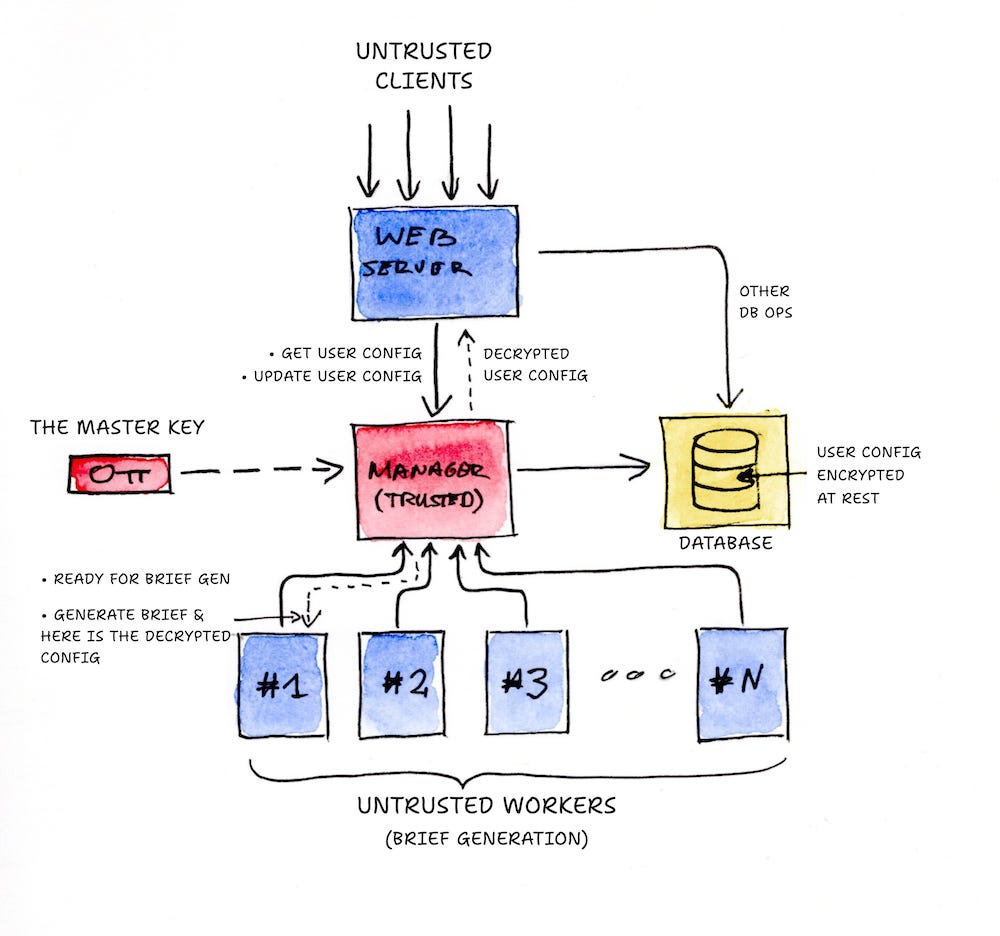
First, Security by Compartmentalization5 has been implemented at the architecture level — briefs are generated by unprivileged worker services, which have no access to the database. Instead, workers are granted only whatever is needed to generate a particular brief. A compromised worker would need to wait until the privileged service — called the manager — decides to hand it data of other users, which only happens when that other user’s brief generation time comes. This might be many hours. And it cannot wait too long, because workers are regularly recycled, so a compromised worker could only steal data of a limited number of users. The web server is similarly de-privileged, and the only service which has keys to the whole DB is not directly reachable by any of the APIs exposed to the users.
Another layer of defense is that all the backend code (including the workers and web server) has been written in Swift, which I consider to be a reasonably safe language.
Finally, all the sensitive fields in the database (such as user API tokens, but also feed URLs and weather locations) are encrypted. The key to decrypt them is handed to the manager service by the hosting environment and is stored as a sealed variable (Railway’s protection mechanism). This prevents a database dump from being immediately usable to an attacker. It does not stop a malicious admin (e.g. me or Railway personnel or someone who compromised Railway’s infrastructure) from decrypting the user data, of course.
In other words, while reasonable measures have been implemented to protect your valuable data, dear user, remember that nothing is 100% bulletproof and use your judgement when handing over various secrets to the app. For my part, I promise to keep everyone informed in case I learn about a compromise affecting either Printed itself or the hosting provider. Also, if you find a vulnerability in Printed, I’d appreciate it if you let me know by email.
Appendix B — Sources, hosting and self-hosting
At this moment, the Printed sources are not publicly available, and I consider this an additional security defense. Today, in the age of powerful models, Security by Obscurity is having its renaissance, I think.
To illustrate this, let me tell you that after implementing the whole compartmentalized architecture described above, I asked Claude Fable to perform a thorough security review6 of the Printed code. Claude found over 30 vulnerabilities, and while none of them was classified as critical (i.e. allowing an attacker to readily steal other users’ data), many were still fairly serious in my view: they allowed an attacker to crash different parts of the service, bypass some quota limits or, under specific circumstances, bypass the additional compartmentalization defenses.
I decided to patch the most serious of these bugs (delaying the public release), such as a sophisticated attack which allowed an attacker who had already compromised the web service to further, opportunistically, leak other users’ model credentials (if they were using self-hosted summarizers). Again, such an attack would require a web service exploit first, and without the compartmentalized architecture discussed above, that alone would already be game over — the additional attack would simply not be needed. Still, the fact that such attacks were found in mere hours made me think that source code access makes it significantly easier for attackers to break a service such as Printed. And so, as much as my heart is with the open-source ideology, I decided to hold off on opening the sources. I want to see what happens first and then, after a few more audits, maybe consider opening them up again. Because I still believe that code, and any knowledge, should be free for anyone.
So, this section, which originally discussed self-hosting options, was rewritten at the last moment, and for now self-hosting is not possible.
As for the Printed service which I run at printed.sh — I use Railway as the hosting platform. Is it the most secure, privacy-friendly and cost-efficient option? I doubt it, but I do appreciate its clean, developer-focused UX and its many integrations with other developer tools. In addition, their response to and disclosure of the recent security incident seem reassuring7. Nota bene, that Railway attack was actually possible because the attacker at some stage gained access to their internal codebase and then managed to scan it for non-obvious vulnerabilities.
Appendix C — AI use disclosure
This post was fully written by me, Joanna Rutkowska, a human. It was proof-read by Claude Opus 5.5.
An early version of Printed, named Coffee Brief, was written (mostly) by me in Swift as an iOS app, back in the fall of 2025. Only late that year did I discover that Claude Opus 4.x was actually a useful coding assistant.
Almost all the Printed code has been written by Claude, various models — from Opus 4.x to Fable 5.x. The work started in spring 2026 and was initially based on my Coffee Brief code (hence all the backend is in Swift), but later diverged significantly. Different parts of the app received different levels of my input. Some almost negligible, while others, like the security architecture mentioned above, were significantly steered by me. I have not read most of the code written by Claude and I don’t carefully review all the PRs.
Claude has access to the GitHub repositories where the Printed code is kept, is able to push PRs and can merge autonomously into the staging branch. It has no permission to merge into the main branch (this is enforced by GitHub), from which the production service, served at printed.sh, is deployed. This separation is possible because the Claude agent runs as a separate GitHub user (Hi, Klaudiusz Programista!). Claude has read-only access to the Railway hosting environment and can monitor the running instances of Printed. It has no access to secrets, such as the master keys and others used to decrypt the database. Or so I hope, based on how Railway sealed variables are supposed to work.
The initial proposal for the Web, written by Tim Berners-Lee in 1989 and distributed in 1990, can be found here.
Memex was a hypothetical device envisioned in the famous article As We May Think, written by Vannevar Bush in 1945 for The Atlantic. Today it could be described as a cross between the Web, Wikipedia, Z-Library and Obsidian, I guess. The original article is still there to read.
Regarding model’s censorship, see e.g. this paper: “What Large Language Models Do Not Talk About: An Empirical Study of Moderation and Censorship Practices” by Sander Noels et al., available at arXiv.
Indeed, it’s hard not to sympathize with those who take a somewhat more radical stance on using AI for their projects. I’m pretty sure lcamtuf wouldn’t approve of my use of Claude for building Printed. Perhaps he’s not wrong? For sure, writing Printed by hand would have been more fun…
I believe I’ve somehow popularized the term Security by Compartmentalization through various publications around the Qubes OS security architecture. I see there is now even a Wikipedia page for the term, which actually uses a diagram I made for some article about Qubes many years ago :-)
Apparently I was lucky and Fable understood that I was the actual author and operator of the service, so it didn’t refuse the audit (and switch to Opus like it’d often do), and instead carried it out, happily burning my tokens.
A few weeks ago (October 2026) there was a sophisticated attack on the Railway infrastructure, which has been described in a reasonable amount of detail on their blog.